

Loving yourself does not have to mean feeling impressive, enjoying every part of your appearance or becoming completely confident. It can mean treating your needs as worth considering, speaking to yourself more fairly and making room for support.
You do not have to master self-love before you can be loved by someone else. Nor does low confidence make you responsible for another person’s harmful behaviour. Start with a particular moment in your day and a response that would make it more manageable.
On this page
Choose one place to begin
Think of a recent situation where you were hard on yourself. Perhaps you made a mistake, needed reassurance or could not finish everything. Separate what happened from the judgement you attached to it.
“I missed an appointment” describes an event. “I ruin everything” turns it into a verdict about your whole life. A fairer response could be: “I missed this appointment. I can apologise, rebook and decide whether a reminder would help.” You can take responsibility without insulting yourself.

Notice the choices available
You may not control your workload, health, income or other people’s responses. Look for a choice within those conditions: asking for clarification, changing the order of two tasks or checking whether someone can help.
If advice to “put yourself first” feels unrealistic, try asking, “Where can my needs be included?” Caring for someone else and caring for yourself do not always compete. A shared plan may serve both of you better than silently taking on more.
Make a practical boundary
A boundary describes what you can offer or what you will do in a situation. Keep it specific enough to act on. For example: “I can talk for twenty minutes tonight,” or “I will take a break if we start insulting each other.”
Consider practical consequences before making a change, especially if you depend on someone for money, housing or care. When a person reacts with threats or intimidation, seek support with safety in mind. You do not have to prove confidence by confronting them alone.
Keep approval in proportion
Wanting to be liked is understandable. The question is whether a particular attempt to gain approval asks you to give up something important. You might choose to cooperate, compromise, say no or ask for time to decide.
Feedback can contain useful information without settling your worth. Ask: “Is there a specific behaviour I want to change?” A vague insult gives you less to work with than a clear, respectful request.
Try a manageable act of courage
Choose an action small enough to practise: state a preference about dinner, ask a question at work or tell a friend you would appreciate company. Feeling nervous does not make the attempt a failure.
Review what actually happened. Did someone respond kindly? Did you need a clearer request? Would a different setting help? Use that information to adjust the next attempt rather than requiring yourself to feel fearless.
Make room for enjoyment and company
You can enjoy time alone and still want connection. Neither preference is a test of whether you love yourself enough. Choose an activity because it interests or comforts you, not because it is supposed to prove independence.
Read a few pages, make something simple, listen to music or invite someone for a short walk if that is accessible to you. If hobbies feel like another obligation, start with a break that requires less effort.
Ask for mutual care
In a relationship, self-kindness can include asking for what would help: a clearer plan, shared chores, affection or a conversation without distractions. The other person can describe their needs too.
Notice the response over time. Respect includes room to decline, disagree and stay connected to other people. You do not need to become perfectly self-sufficient before asking a partner or friend to treat you considerately.
Allow difficult feelings
Rest, disappointment, loneliness and anger can coexist with care for yourself. You do not have to turn every feeling into gratitude or choose happiness on command.
If spiritual reflection is part of your life, you might use a reading, prayer or journal to explore a question. Keep room for uncertainty and practical information. A hopeful interpretation does not require you to ignore your own needs or wait for a promised outcome.
Review and seek support
At the end of the day, notice one occasion when you responded more fairly, and one thing you need tomorrow. Progress may be asking for help or doing less, rather than adding another task.
The NHS guide to low self-esteem suggests questioning harsh beliefs, treating yourself with kindness and practising assertiveness. It also describes talking therapies as an option. If persistent self-criticism or distress is making daily life difficult, a qualified professional can help you explore support.
For today, choose one action: eat something, correct an unfair thought, make a realistic request or contact someone you trust. You can begin without feeling ready to call it self-love.
Give yourself the same practical care you would offer a friend
If you feel you failed because you could not help everyone, describe the actual limit you faced. You may have had one hour and three requests. You can say what you are able to do and schedule time for something you also need.
Use a small, specific way to respond to the feeling. A different routine or a respectful no can make the next decision easier without requiring you to feel confident about it immediately.
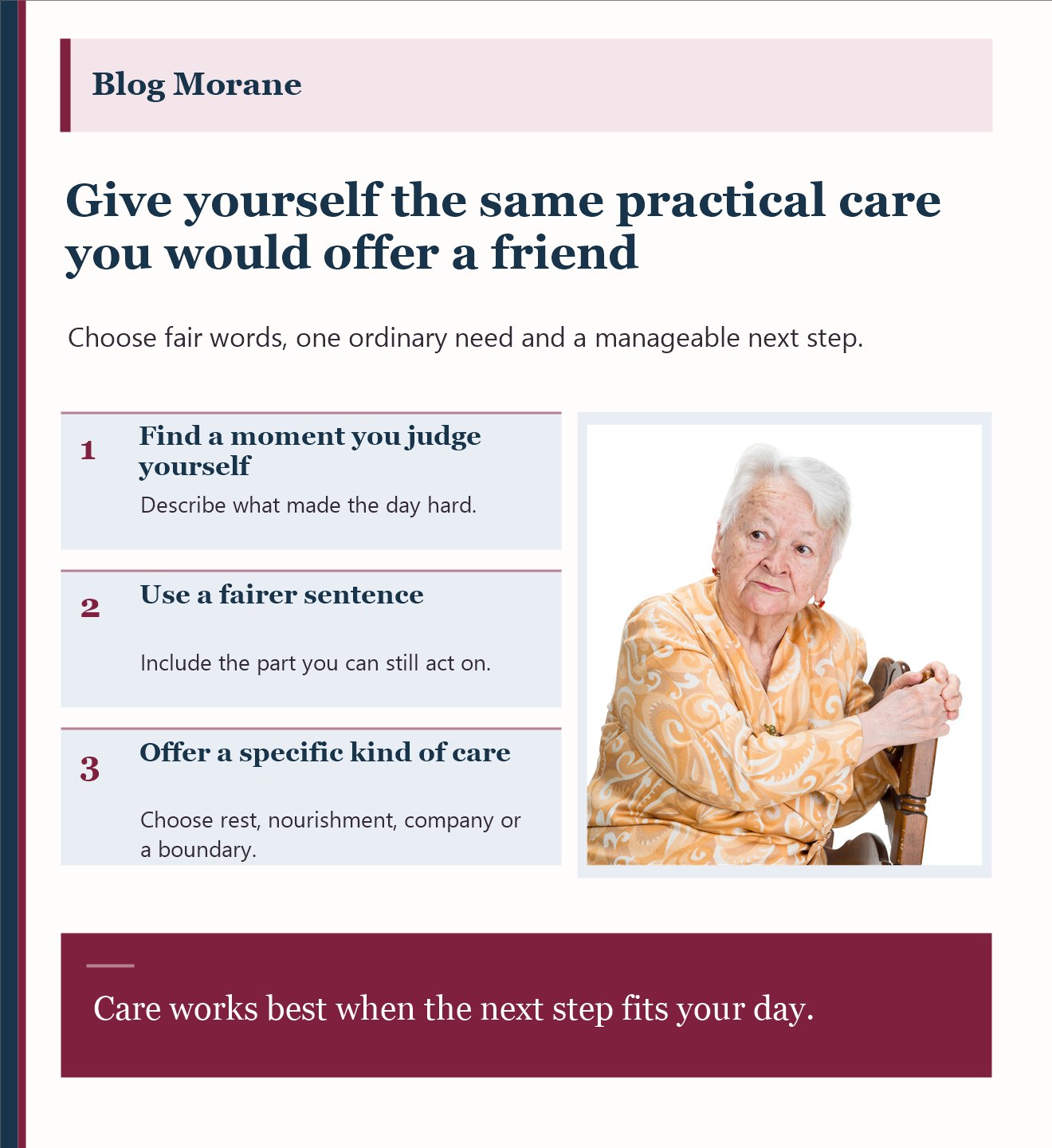
Read the infographic in text
Give yourself the same practical care you would offer a friend
Choose fair words, one ordinary need and a manageable next step.
- Find a moment you judge yourself Describe what made the day hard.
- Use a fairer sentence Include the part you can still act on.
- Offer a specific kind of care Choose rest, nourishment, company or a boundary.
Care works best when the next step fits your day.