

A short dating message can become a long editing project when you hope the right wording will prevent rejection or misunderstanding. A clear text can communicate a request. It cannot guarantee the reply, remove uncertainty or establish what another person feels.
Decide what the message needs to do
Before rewriting, name the purpose: arrange a meeting, answer a question, express interest, clarify a plan or state a boundary. If you cannot identify the purpose, pause before sending more words.
Keep facts separate from guesses. “They have not replied since yesterday” is a fact. “They are trying to punish me” is an interpretation you cannot verify from the delay alone.
Write the plain version first
Use enough information for a response, including the relevant day, place or question. For example: “I enjoyed Saturday. Would you like to get coffee on Thursday evening?”
Compare that with a message full of apologies and escape routes: “Sorry if this is weird, and no worries if you’re busy, but maybe…” You do not need to apologize for a respectful invitation. The other person remains free to decline.
Ask one clear question
A message that asks about plans, feelings, commitment and a past disagreement at once may be hard to answer. Choose the part that needs a response now.
- Plans: “Are we still meeting at six?”
- Preference: “Would you prefer a call or to talk in person?”
- Boundary: “I cannot discuss this while I’m working. I can call this evening.”
- Clarification: “When you said you wanted more space, what contact did you have in mind?”
You can be warm and direct at the same time. You do not have to imitate indifference to protect your dignity.
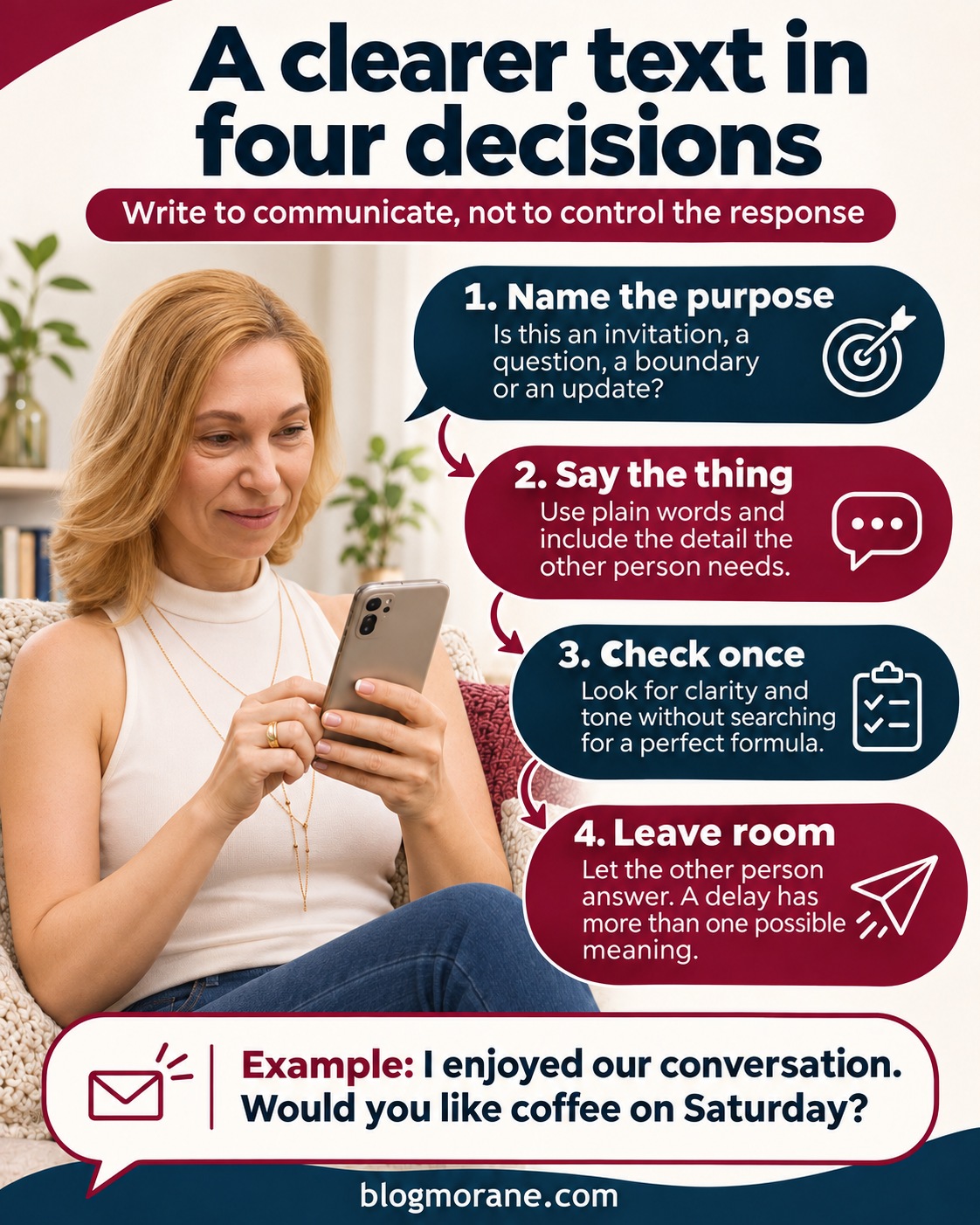
Read the visual guide as text
- Name the purpose. Is this an invitation, a question, a boundary or an update?
- Say the thing. Use plain words and include the detail the other person needs.
- Check once. Look for clarity and tone without searching for a perfect formula.
- Leave room. Let the other person answer. A delay has more than one possible meaning.
Example: I enjoyed our conversation. Would you like coffee on Saturday?
Choose a reasonable finishing point
Check whether the message is accurate, understandable and respectful. Correct an important error, then decide whether another revision adds useful information or only tries to remove discomfort.
A stopping rule such as one content check may help with an ordinary message. It is not a rule for legal, safety or other high-stakes communication. If the subject needs careful advice, obtain that advice.
Know when a conversation would work better
Text is useful for some arrangements but may be a poor fit for a complex disagreement. Suggest another format without demanding immediate access: “This seems hard to explain by text. Could we talk tomorrow?”
Where there is fear, monitoring or coercion, a direct conversation may be unsafe. Seek appropriate confidential support rather than treating clearer wording as the solution to threatening behavior.
Let the other person have time to answer
After sending, return to another ordinary task. You do not need to keep checking the screen or ask several friends to interpret every punctuation mark. Different work schedules and communication habits can affect response times.
Follow up when there is a practical reason, such as confirming a time-sensitive plan. Keep the follow-up clear. Repeated messages cannot create a willing response.
Over time, notice whether the relationship allows normal questions, clear refusals and respectful disagreement. The pattern matters more than one perfectly composed text. If worry about messages becomes persistent or disruptive, consider support for the worry as well as the communication.
Send the message that says what you mean, while leaving the reply where it belongs: with the other person.