

If you often become the person who listens, organises and helps, it can be difficult to notice when you have run out of room. Feeling overwhelmed does not mean that caring is your destiny or that you should give even more.
Boundaries help make your availability clearer. You can value a relationship while considering your own time, needs and responsibilities. Start with one request or recurring situation rather than trying to change every relationship at once.
On this page
Notice signs of overload
Look for concrete patterns: agreeing before checking your calendar, missing meals to finish another task or dreading a familiar request. Ask what you have already committed to and what would have to give way if you said yes.
These observations can guide a decision. They do not establish that you are selfish, unusually sensitive or responsible for everyone else’s feelings.
Include your own needs in the decision
A need does not become unimportant because someone else’s need is more visible. Rest, work, health, private time and other relationships all deserve consideration.
Try asking, “What can I offer without neglecting something essential?” Sometimes the answer is a smaller contribution. Sometimes it is no.
Give a clear response
You can be brief: “I cannot take that on this week,” or “I can listen for twenty minutes.” An explanation is optional; adding more reasons can create more points for someone to debate.
Offer an alternative only if you want to and can follow through. A reluctant alternative that costs just as much as the original request does not solve the problem.
Take time to decide when you can
For a non-urgent request, try “Let me check and get back to you tomorrow.” Choose a response time that fits the situation; there is no universal twenty-four-hour rule.
Use that pause to check the task, timing and resources. If you have agreed and then realise the commitment is unrealistic, explain promptly what you can actually do.
Make the boundary practical
Describe the limit and the action available to you: “I do not answer routine work messages after dinner, so I will reply the next working day.” A boundary is easier to use when it is specific.
The love is respect guide to boundaries explains how they express your needs and choices. A boundary should protect those choices rather than control another person’s friendships or private life.
Notice how the other person responds
Someone may be disappointed and still respect your answer. Look at what happens next: can they hear the limit, discuss options and accept that your availability is real?
Repeated insults, threats or punishment are different from disappointment. If saying no could put you at risk, seek specialist support and consider safety before trying a direct confrontation.
Allow guilt without changing every answer
Guilt can appear when you change an old pattern. The feeling does not automatically mean your decision was wrong. Review the facts: what did you agree to, what is possible now and whose responsibility is the task?
You can care about someone’s difficulty without taking over the whole solution. If you caused a problem, acknowledge that honestly while keeping any limits you still need.

Ask for practical help
Name a task that could be shared, reduced or delayed. “Can you arrange transport this time?” is easier to act on than “I need everyone to help more.” Where duties are ongoing, a clear shared plan may help.
If caring responsibilities regularly exceed what you can manage, explore local support or professional advice relevant to the situation. Personal boundaries cannot replace resources that are missing.
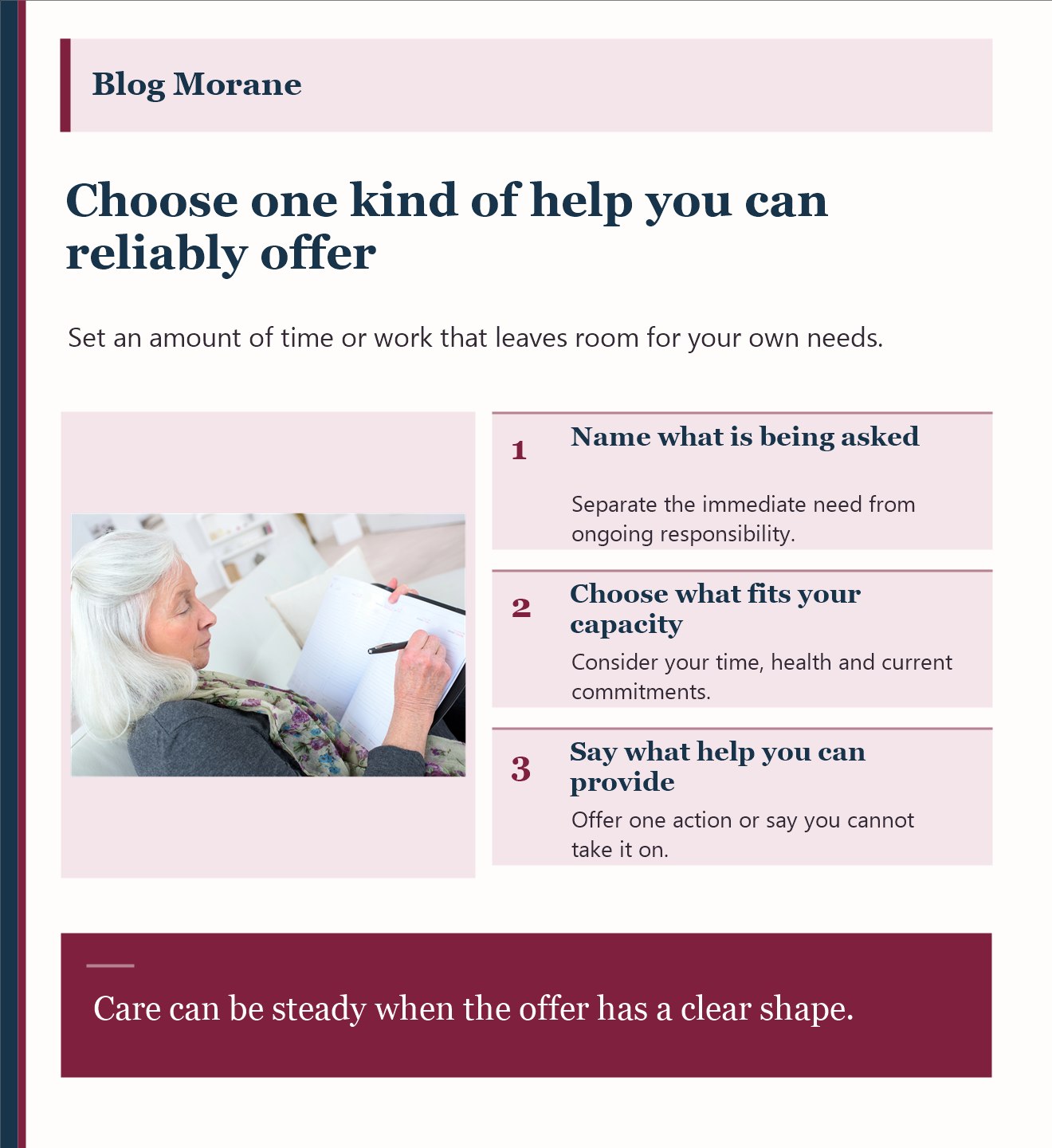
Choose one kind of help you can reliably offer
If a relative asks you to help with weekly errands, decide what you could do without creating another obligation you cannot meet. You might offer one ride this week and ask whether someone else can cover the next date.
If the request is urgent or ongoing, point the person toward an appropriate support service when you can. Keep your own rest and responsibilities part of the decision.
Read the infographic in text
Choose one kind of help you can reliably offer
Set an amount of time or work that leaves room for your own needs.
- Name what is being asked Separate the immediate need from ongoing responsibility.
- Choose what fits your capacity Consider your time, health and current commitments.
- Say what help you can provide Offer one action or say you cannot take it on.
Care can be steady when the offer has a clear shape.