

Dating after divorce can bring curiosity, hope, grief and uncertainty at the same time. You can want companionship while still making sense of the relationship that ended. There is no single waiting period or emotional test that decides when you may date.
These five common pressures are worth stepping away from as you work out what feels right for you.

1. The pressure to follow someone else’s timetable
Friends may urge you to get back out there or insist that you wait. You can listen and make your own choice. Instead of asking whether you are completely “over” your ex, consider whether you want this particular experience and have room for it now.
A short coffee may suit you better than frequent messaging or a long evening. You can pause, change your mind or decide that dating is not what you want. Ongoing sadness does not automatically make someone incapable of a respectful relationship.
2. The pressure to make every date prove your worth
Wanting reassurance after a painful ending is understandable. Still, another person’s interest is a limited piece of information about compatibility and timing, not a verdict on your value.
Keep your early expectations specific: “I want to see whether conversation feels comfortable,” rather than “This has to become a relationship.” If you are not a match, you can be disappointed and seek support without turning the experience into evidence that you have failed.
3. The pressure to rush into—or avoid—exclusivity
You do not have to date several people, and you do not have to become exclusive quickly. Discuss what you both want rather than assuming that frequent contact creates an agreement.
Be clear about whether you are seeing other people, what exclusivity means to you and what pace feels comfortable. Consent to one date, physical affection or a relationship can be reconsidered. Neither person owes the other a commitment because of money spent or time invested.
4. The pressure to handle everything alone
Needing support does not make you weak or unsuitable for dating. Friends, family, community connections or professional support may help you navigate the changes around a divorce. A new partner can offer care while still being a separate person with their own limits.
Keep room for responsibilities and interests that matter to you. If you have children, protect their privacy in early conversations and think carefully about the pace of introductions. Do not expect them to manage your feelings about the divorce or assess a new partner for you.
5. The pressure to explain away discomfort
You can decline another date without proving that the person has done something wrong. Notice their response to ordinary limits: do they accept a different time, respect your privacy and hear “no” without bargaining or punishment?
You might say, “I am not ready to share my address,” or “I enjoyed meeting, but I do not want another date.” The love is respect guide to personal boundaries explains how boundaries express your needs and choices, and why respecting them matters.
For a first meeting, choose a public place, arrange your own way home and let a trusted person know your plan. If someone threatens, monitors or frightens you, prioritise safety and specialist support rather than confronting them alone.
You can judge the next step by the experience in front of you: did you feel heard, could you make choices freely, and would you like to meet again? A careful pace leaves room for interest and for changing your mind.
Decide which pressure you want to take out of dating after divorce
If friends expect you to start dating as soon as a divorce is final, give yourself a time to consider what you want. You may choose one group activity without an expectation of meeting someone, or decide that a short date would feel good now.
Check the result against the time and privacy you need. You can move differently from someone who had a similar experience and still be making a practical choice.
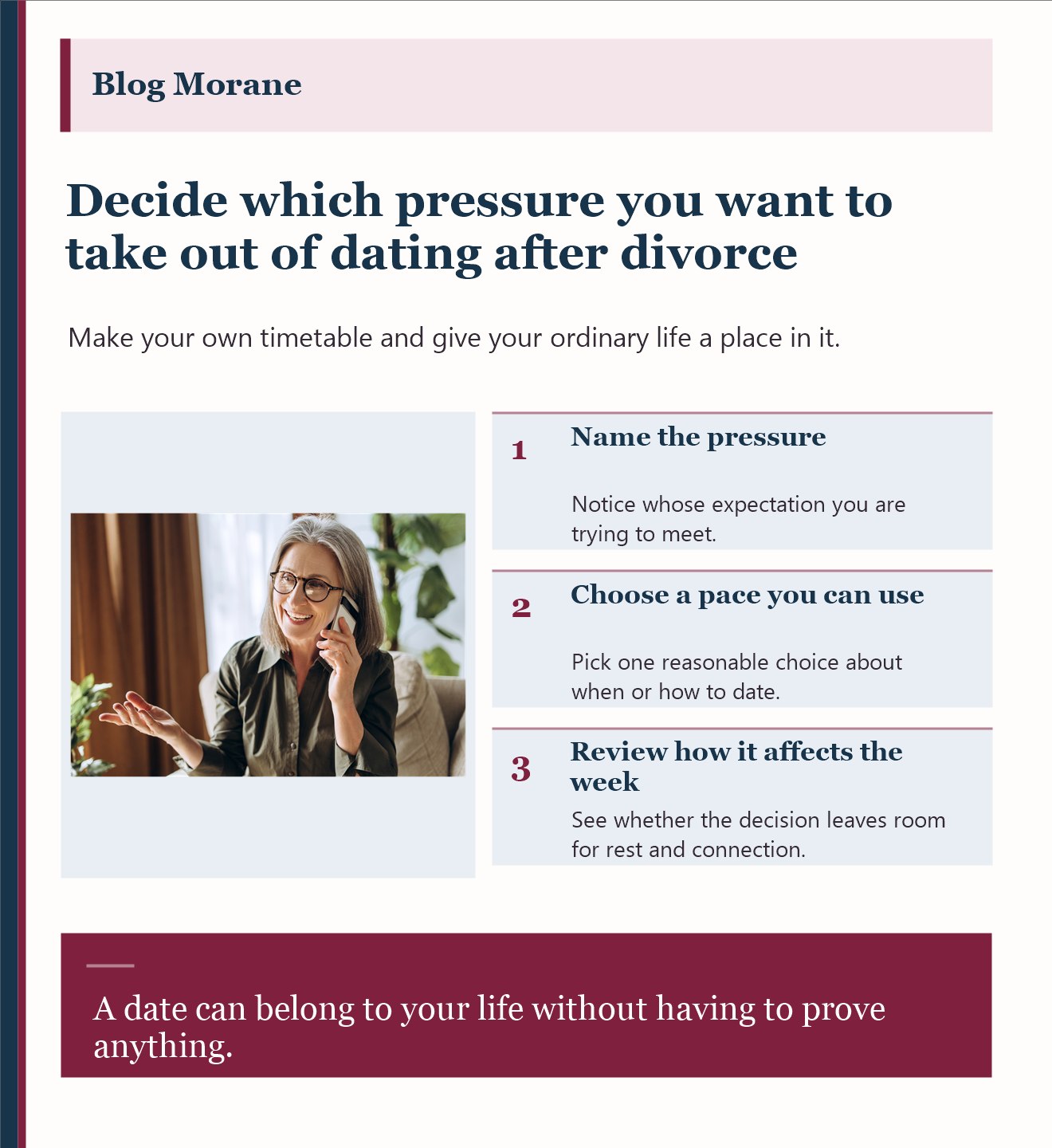
Read the infographic in text
Decide which pressure you want to take out of dating after divorce
Make your own timetable and give your ordinary life a place in it.
- Name the pressure Notice whose expectation you are trying to meet.
- Choose a pace you can use Pick one reasonable choice about when or how to date.
- Review how it affects the week See whether the decision leaves room for rest and connection.
A date can belong to your life without having to prove anything.