

You can still love someone after a relationship has ended. Missing them, wanting an explanation or remembering good moments does not mean you have failed to move forward. The question for today may be how to care for yourself while those feelings are present.
There is no timetable that everyone must follow. You also do not have to wait until the feelings disappear before asking for support or making practical changes. Start with what makes daily life more manageable and respects both people’s choices.
On this page
- Leave the deadline aside
- Notice what you are feeling
- Choose suitable contact limits
- Separate the ending from your worth
- Write without reopening every question
- Use the energy you have
- Let forgiveness be a choice
- Respond to repeated “what ifs”
- Keep room for other connections
- Ask for more support when needed
Leave the deadline aside
A friend’s recovery, a social media rule or the length of the relationship cannot tell you when you should stop feeling sad. Notice your own needs instead: whether you are sleeping, managing essential tasks and getting enough support.
You can have a steadier day followed by a difficult one. A reminder or an anniversary does not erase the steps you have already taken.
Notice what you are feeling
Try a description such as “I miss the companionship” or “I am angry about how it ended.” Specific words can help you decide whether you want company, a private pause or help with an unresolved practical problem.
You do not need to share everything or force yourself to relive painful details. Choose a way of expressing yourself that feels manageable.

Choose suitable contact limits
Seeing updates or rereading messages may make some days harder. Muting notifications, archiving a conversation or moving photos out of immediate view are options. You do not have to permanently delete memories to prove you are recovering.
If you share childcare, work or other responsibilities, consider a specific channel and practical topics for contact. Preserve information you need for safety, agreements or professional advice. Respect a request for no personal contact, even when you want another conversation.
Separate the ending from your worth
A relationship ending is not proof that you are unlovable. You may have things to learn or mistakes to address, but those are more useful to consider as particular actions than as a verdict on who you are.
Try asking, “What would I say to a friend in this situation?” You can be honest without being cruel to yourself.
Write without reopening every question
If writing helps, give it a small purpose: name what you miss, record something that was difficult or decide what you need tomorrow. You can hold good and painful memories together without proving that the whole relationship was either perfect or worthless.
If journaling leaves you more distressed, stop or choose something different. It is an option, not a recovery requirement.
Use the energy you have
Some days may allow a walk, a hobby or a visit. Other days may call for a simple meal, clean clothes or help with an essential task. Pick something that fits your health, access and capacity.
Activity does not have to erase sadness to be useful. A short break from thinking about the relationship can still make the day easier.
Let forgiveness be a choice
You do not have to forgive someone, reconcile or obtain an apology before caring for yourself. Forgiveness, if it matters to you, can be considered in your own time. It does not require renewed contact or removing a boundary.
When harm or intimidation was involved, support and safety can take priority over trying to understand the other person’s reasons.
Respond to repeated “what ifs”
Ask whether a question has a practical answer available now. If you can clarify a shared bill, make that plan. If you are replaying a conversation for the twentieth time without new information, note the question and turn to a task or person in the present.
You can leave some things unanswered. A spiritual interpretation may have personal meaning, but it cannot establish why another person left or guarantee who will enter your life next.
Keep room for other connections
Ask for the kind of company you want: a short call, a meal together or a conversation about something else. Friends may not know what would help until you tell them.
Dating again is optional. You do not have to find another partner to validate your progress, and you can decide what you feel ready to share with someone new.
Ask for more support when needed
The NHS guide to grief and loss includes the end of a relationship and describes different feelings and sources of help. If distress is persistent, worsening or making daily life difficult, consider speaking with a healthcare professional or counsellor. You can ask for help before things become a crisis.
For now, choose one thing you need today and one person or service you could contact. There is no need to solve the rest of your life at once.
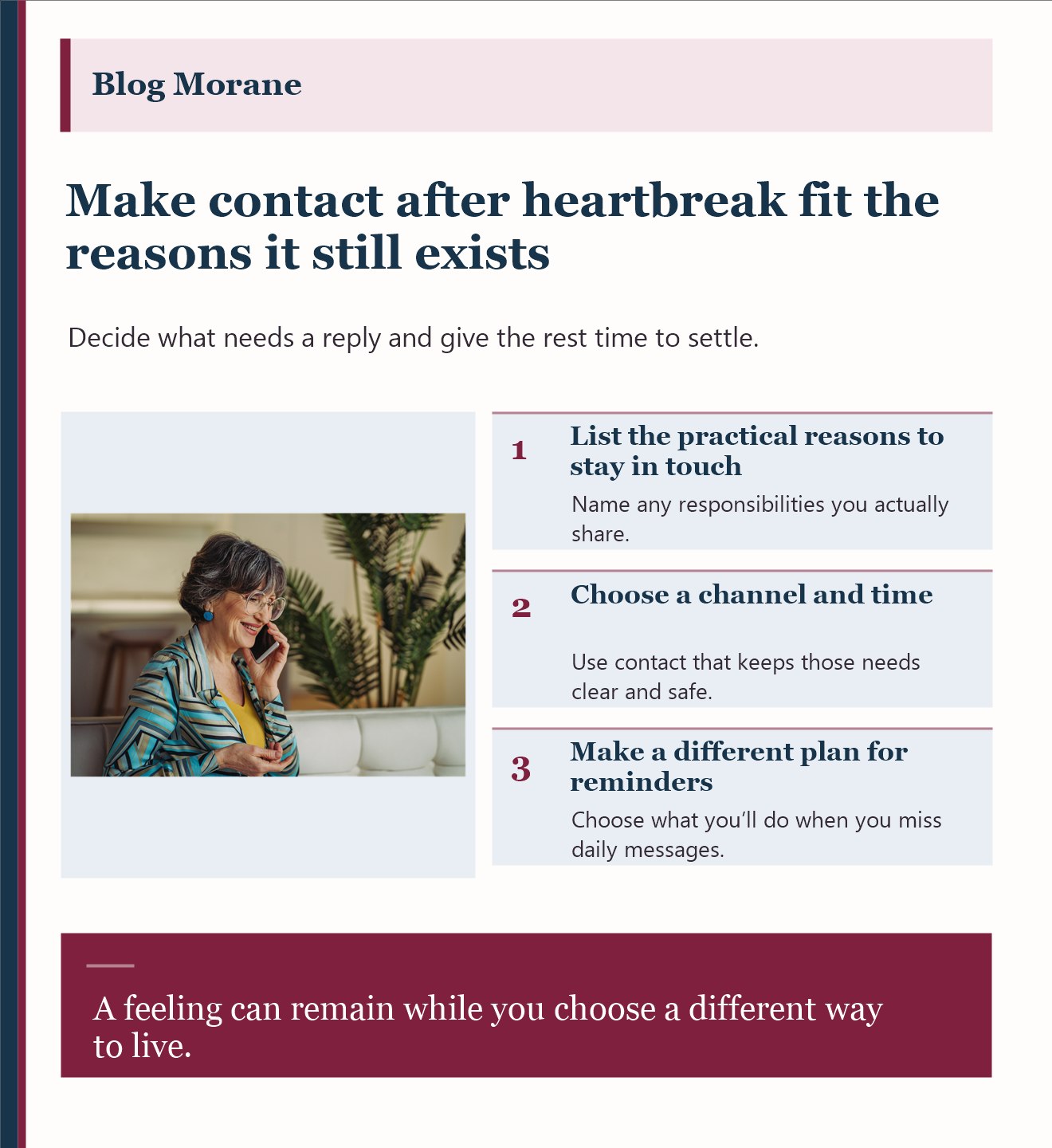
Make contact after heartbreak fit the reasons it still exists
If your former partner still collects mail or shares a bill, pick a way to handle that one subject. Put ordinary reminders in a different plan, such as moving a routine call to someone you trust or trying an activity at the hour you used to talk.
If contact feels unsafe or keeps getting pushed beyond what you agreed, seek support when you decide how to change it. You can give yourself room to grieve without explaining every feeling to your ex.
Read the infographic in text
Make contact after heartbreak fit the reasons it still exists
Decide what needs a reply and give the rest time to settle.
- List the practical reasons to stay in touch Name any responsibilities you actually share.
- Choose a channel and time Use contact that keeps those needs clear and safe.
- Make a different plan for reminders Choose what you’ll do when you miss daily messages.
A feeling can remain while you choose a different way to live.