

A goal can matter to you and still be difficult to act on. Time, money, health, caring responsibilities and uncertainty can affect a plan. When you keep putting something off, ask what is making the next step difficult before deciding that you lack discipline.
Sticking to a goal can include changing the route, reducing its size or deciding that it no longer fits. Start with a plan you can try, then use what happens to decide what to do next.
On this page
Choose one workable goal
Describe what you want in terms you can recognise. “Explore whether a different job would suit me” may be more workable than “Transform my whole career.” The next action could be reading two current job descriptions or asking about a training requirement.
Distinguish an action you can take from an outcome that depends on other people. You can prepare an application; you cannot guarantee an offer. A useful plan leaves room for that difference.
Identify the support and resources
Ask what the action needs: information, a quiet place, transport, equipment, an adjustment or someone to share a responsibility. Encouragement can be welcome, but it cannot replace a missing practical resource.
Make a specific request where possible: “Could you read this draft?” or “Can we arrange an hour when I can work without interruption?” If the support is not available, adjust the plan rather than assuming you should be able to push through every obstacle.

Use reminders that lead to action
A note, calendar entry or vision board can remind you what matters. Connect the reminder to something you can do. A picture of a qualification might sit beside the name of the course provider and the next question you need to ask.
Keep private goals private if you prefer. You do not need to announce a plan publicly or buy a particular planner to take it seriously. If a reminder creates guilt without helping you start, change or remove it.
Rehearse the next step
You might imagine opening the document, making the call or arriving at the class. Then consider an ordinary obstacle: you are unsure what to ask, the room is noisy or the task is larger than expected.
Prepare a response, such as writing the first question beforehand or asking for a clearer brief. Visualising a desired outcome can be meaningful, including as a spiritual practice, but it does not make the result certain. Give the practical action a place in the plan.
Plan for low-motivation days
Choose a smaller version of the action that is still useful. Read one paragraph, gather the relevant document or write a rough first sentence. You can stop after that step and decide whether more is manageable.
The NHS guide to tackling your to-do list suggests approaches such as brief starting periods and balancing necessary tasks with enjoyable activities. Try an approach that fits your circumstances, and change it if it is not helping.
Review, rest and revise
At your check-in, ask what actually happened. Was the task clear? Was the planned time available? Did a cost, access need or other demand become important? Use the answers to change the next attempt.
Rest and ordinary life need space in the plan. You can continue, pause, ask for help or stop pursuing a goal that no longer serves you. Changing direction after learning more is a decision, not a character failure.
For today, write down one action and what it needs. Leave the larger outcome open while you gather experience and information.
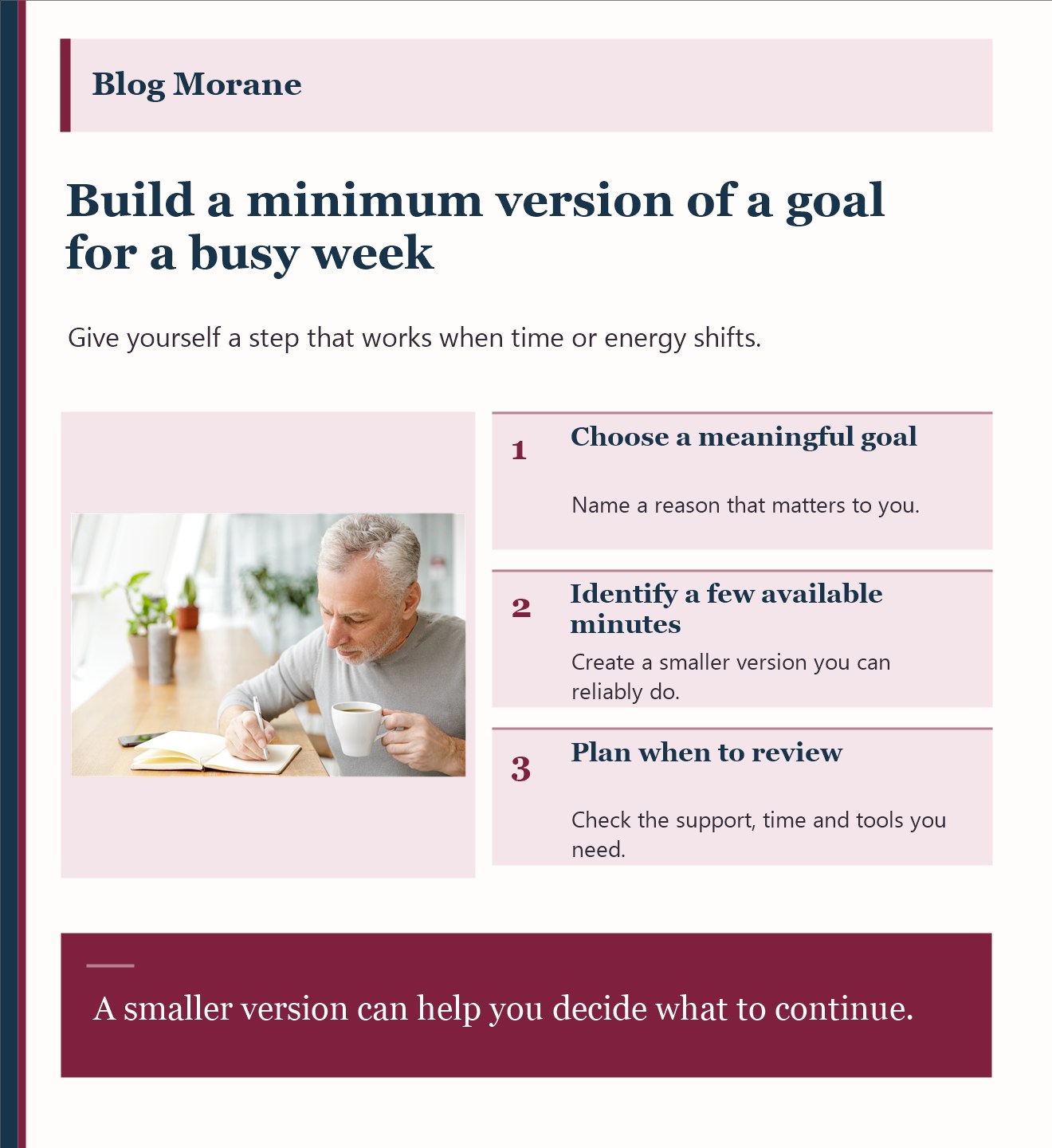
Build a minimum version of a goal for a busy week
If you want to take a class but have a changing work schedule, make the first step finding one lesson that fits and setting time to look at it. Before committing to more, check whether the schedule, travel and cost are workable.
Keep track of what helps you take the step. When your circumstances change, you can change the goal itself or choose a different way to pursue it.
Read the infographic in text
Build a minimum version of a goal for a busy week
Give yourself a step that works when time or energy shifts.
- Choose a meaningful goal Name a reason that matters to you.
- Identify a few available minutes Create a smaller version you can reliably do.
- Plan when to review Check the support, time and tools you need.
A smaller version can help you decide what to continue.