

Self-esteem concerns how you see and value yourself. When that view becomes harsh, a mistake or disappointment can start to feel like proof that you are not good enough. A useful place to begin is the particular situation, rather than a demand to feel positive about your whole life.
Low self-esteem or depression is not evidence that you lack gratitude or have failed to think correctly. Experiences, health, relationships and circumstances matter. You can look for fairer ways to respond to yourself while getting the support you need.
On this page
Notice a harsh thinking habit
Think of a moment when you criticised yourself. What actually happened? “I needed help with this task” describes an event. “I am incapable of doing anything” turns one event into a judgement about your whole life.
Try a statement that includes both difficulty and possibility: “This was unfamiliar. I can ask someone to explain the first step.” You can take a mistake seriously without using it to insult yourself.

Ask for useful support
Choose the kind of help that fits the situation. You might want someone to listen, explain a task, practise a conversation or help you find professional support. A specific request can give the other person something practical to respond to.
You do not have to tell everyone how you feel. Start with someone who respects your privacy and can hear a concern without using it against you.
Choose words you can believe
An affirmation may be helpful if it feels credible, but you do not have to repeat a phrase that makes you feel more disconnected from your experience. “I am allowed to learn” may be easier to work with than “I am brilliant at everything.”
You could keep a short note of something you handled, a quality you value or an occasion when you asked for what you needed. Include ordinary examples. Resting when exhausted can be a considered choice, even when it produces nothing to display.
Look at how people treat you
Notice behaviour rather than labelling people as positive or negative. Does someone listen, respect a refusal and speak to you without humiliation? Can you disagree without being threatened?
You may be able to make a request, limit a conversation or spend more time with supportive people. If you depend on someone for care, housing or money, changes may need planning and outside support. You are not failing because you cannot simply walk away.
Make gratitude optional
Noticing something you appreciate can be meaningful, but it does not cancel grief, unfairness or unmet needs. You can value a friendship and still feel lonely, or appreciate your work and need a more manageable workload.
If a gratitude exercise feels like pressure, leave it aside. Try a practical question instead: “What would make the next part of today a little easier?”
Include your present needs
Before interpreting a difficult day as a flaw in your character, check what is happening around you. Are you tired, under pressure, missing information or trying to meet conflicting demands?
Choose a response that fits. That might be eating, resting, asking for clarification or dividing a task into smaller parts. You can plan for tomorrow without requiring yourself to stop feeling uncertain today.
Keep worth separate from usefulness
Helping other people may give you connection or satisfaction. It can also become exhausting if every request feels like a test of whether you deserve to be liked.
Choose an amount of help you can offer freely. You can say, “I can help for half an hour,” or “I cannot take this on this week.” Your value does not disappear when you need care yourself.
Review small changes and seek support
Look for specific changes: you asked a question, corrected an unfair judgement or kept a manageable boundary. A difficult day afterwards does not invalidate those actions.
The NHS guide to low self-esteem describes ways to question harsh beliefs, practise assertiveness and find talking therapy support. If self-criticism or distress is persistent or affecting daily life, a qualified professional can help you consider what support fits.
Choose one fairer response to practise today. It is enough to begin with an action, even if your feelings take longer to change.
Answer a harsh self-judgment with one real example
If you catch yourself thinking you always disappoint people, recall a real promise you kept or an apology you made after missing one. Explain what happened as you would to a friend, including what you were able to do.
Keep a note of the example for the next time the thought returns. If self-criticism frequently affects daily life, consider qualified support to work through it.
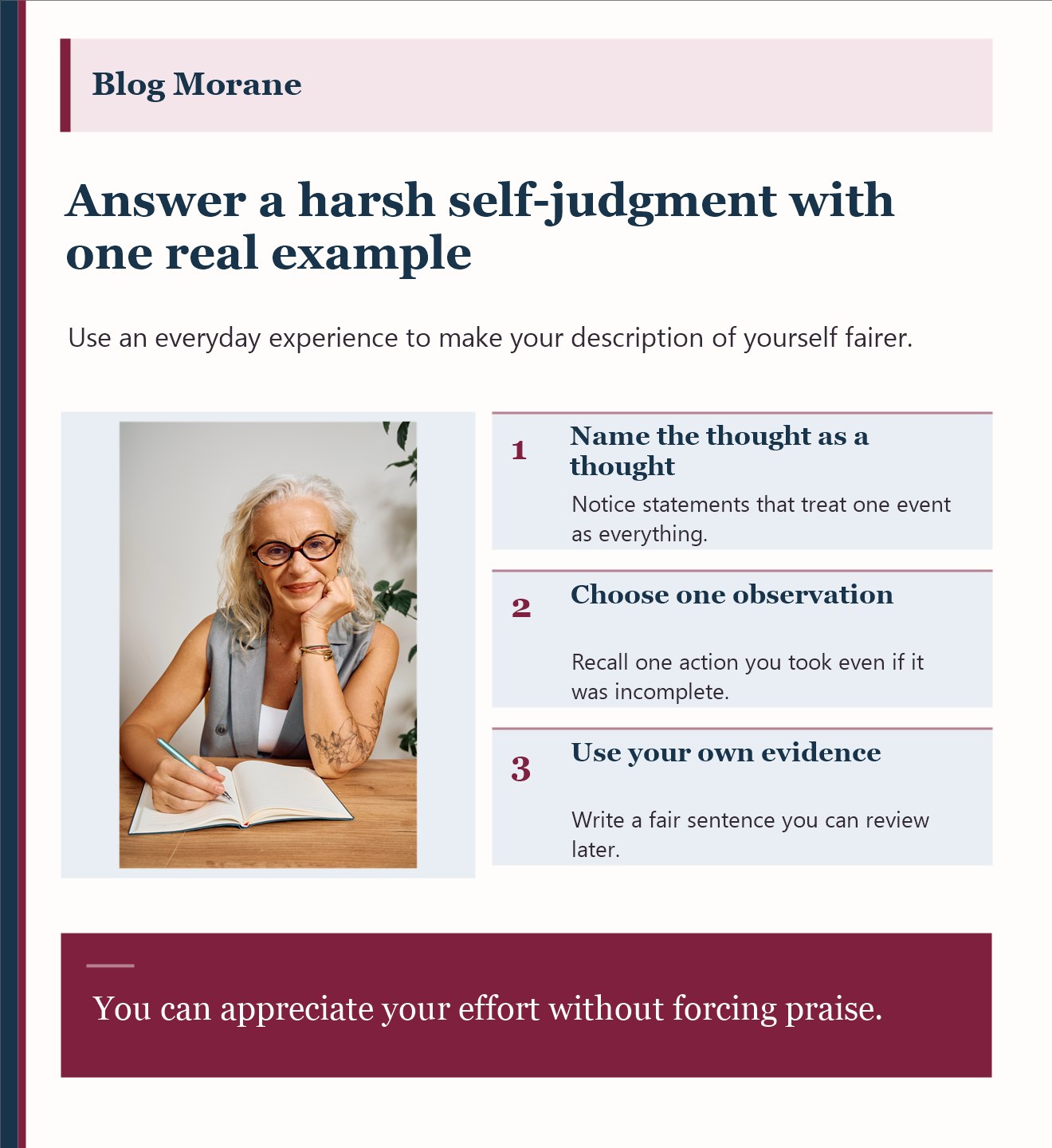
Read the infographic in text
Answer a harsh self-judgment with one real example
Use an everyday experience to make your description of yourself fairer.
- Name the thought as a thought Notice statements that treat one event as everything.
- Choose one observation Recall one action you took even if it was incomplete.
- Use your own evidence Write a fair sentence you can review later.
You can appreciate your effort without forcing praise.