

Being yourself in a relationship can mean expressing a preference, admitting that something is difficult or making room for an interest your partner does not share. You do not have to perform constant happiness or agree with everything to deserve care.
You also get to choose what to share and when. Consider where you feel free to speak, where you hold back and what happens when you disagree. Use those observations to decide what needs a conversation, a practical change or support.
On this page
1. Notice where you hold back
Think of a recent ordinary situation. Did you say that a plan suited you when it did not? Pretend to enjoy an activity? Avoid mentioning that you were tired? Write down what you wanted to say and what made saying it difficult.
There may be different reasons for holding back: wanting time to think, avoiding an awkward moment, following an old habit or fearing a response. A private note can help you identify the situation without deciding immediately what it means about the whole relationship.
Changing how you speak in different settings does not automatically mean you are being false. You may use different language at work, with family or with a partner. Ask whether the adjustment is a choice you are comfortable with, or whether you feel unable to express something important.

2. Name a need or preference
Move from a broad judgement such as “I never get to be myself” to an example you can discuss. You might need time alone after work, a fairer share of household planning or freedom to keep a hobby. Give the need enough detail that you understand what would change.
- What matters? “I want to keep my weekly class.”
- What is happening? “We have been making other plans during that time.”
- What would help? “I would like us to check the calendar before committing.”
You do not have to rank every preference as essential. Some choices are flexible; others concern your values, safety or consent. Knowing the difference can help you decide where you want discussion and where you need a clear limit.
Our article Being Yourself: Values, Privacy and Everyday Choices offers more ways to explore what matters to you.
3. Try one clear conversation
Where it feels safe to talk, choose one concern rather than presenting a complete account of every disappointment. You might say, “I have been agreeing to extra plans when I need rest. I want to be clearer about what I can manage.”
Ask for the kind of conversation you want: “Could you listen first, then we can work out the schedule?” Leave room for your partner’s needs too. A different preference does not have to become a contest over whose feelings are more legitimate.
You can pause to think or choose a comfortable way to communicate. You do not need a perfect speech or a display of confidence. If you express something poorly, clarify it. If you hurt someone, take responsibility for the specific behaviour without deciding that honesty itself was a mistake.
Listening matters alongside speaking. See When Empathy Feels Difficult: Listening and Care for practical ways to understand a concern before responding.
4. Keep privacy and choice
Being open does not require handing over every private thought, account or conversation. Consider what you want to keep personal and what arrangements you are comfortable sharing. You can be truthful about a limit: “I am not ready to discuss that yet.”
Digital expectations deserve their own conversation. Ask before posting a photo of your partner or sharing a private message. Discuss what feels reasonable around tagging, public relationship updates and messaging, rather than assuming that being together means automatic permission.
The love is respect guide to digital boundaries explains online privacy, changing preferences and keeping passwords private. Consent to one arrangement does not remove your ability to reconsider it. You can ask for privacy without having to prove that you have nothing to hide.
5. Look at behaviour and repair
Notice what happens after you raise a concern. Is there room to discuss it? Is an agreement followed through? If someone apologises, what changes afterward? Use specific examples rather than trying to prove what another person truly feels inside.
New York State’s healthy-relationship guide describes respect, independence, communication and decisions made without fear of retaliation. It also cautions that trying to enforce boundaries in an abusive relationship can increase risk.
A disagreement, hurt feeling or ending does not by itself prove that love never existed. At the same time, loving words do not make threats, coercion or repeated humiliation acceptable. You can take harmful behaviour seriously without first settling a question about the person’s feelings.
6. Reflect on beliefs and intuition
You may draw meaning from faith, spiritual beliefs or a sense of intuition. Give those reflections room alongside what is happening in the relationship. A strong feeling can prompt a question; it does not have to serve as a final verdict about another person.
Ask what you have noticed, what you do not know and what support would help you think. Our guide Fear and Intuition: Reflection, Evidence and Support offers a way to consider feelings without treating them as guaranteed predictions.
You do not need to call a painful relationship a gift, a necessary lesson or part of the universe’s plan. You can choose a meaning that fits your beliefs, or leave the question unanswered while you attend to your needs.
7. Choose your pace and support
You may decide to continue a conversation, request a practical change, take time to think or consider ending the relationship. Look at your circumstances, including housing, money, dependants and available support. Avoid measuring your courage by how quickly you make a decision.
If you fear a partner’s reaction or experience threats or control, seek individual support from a domestic-abuse service using a safer device if possible. You do not need to confront the person or announce plans to prove that you are being authentic. If you are in immediate danger, contact local emergency services.
For an ordinary next step, choose one preference you want to acknowledge, one question you want to ask or one person you can turn to. You can learn about yourself over time while treating both your needs and other people’s choices with care.
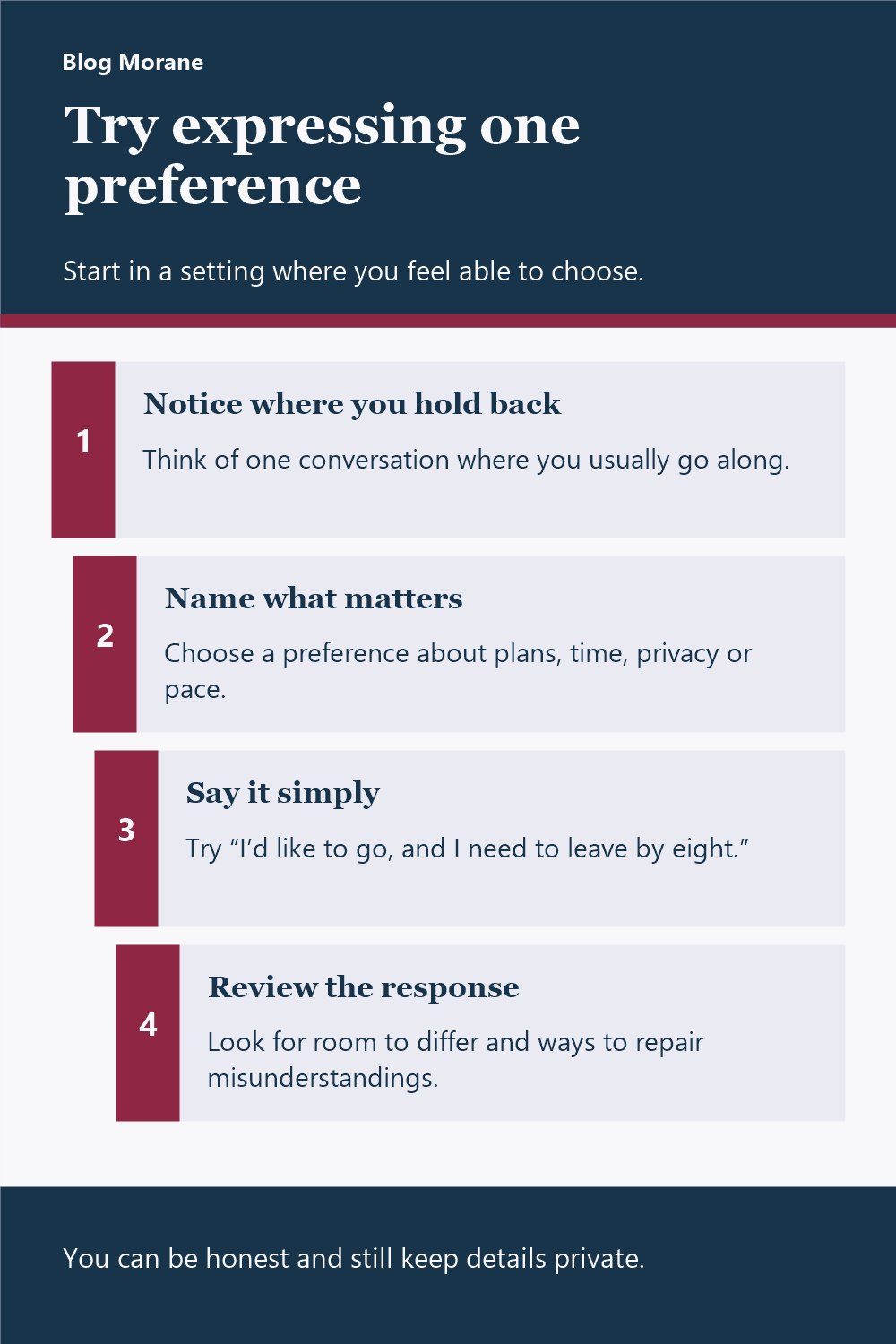
Read the infographic in text
Try expressing one preference Start in a setting where you feel able to choose.
- Notice where you hold back Think of one conversation where you usually go along.
- Name what matters Choose a preference about plans, time, privacy or pace.
- Say it simply Try “I’d like to go, and I need to leave by eight.”
- Review the response Look for room to differ and ways to repair misunderstandings.
You can be honest and still keep details private.